

did you know that i am one of the few people left in the (technologically) developed (and ever-advancing) world that still has to write a tangible roughout on paper?
is it clear that i make mistakes and need to see these mistakes scratched out in blue ink and later corrected in red?
yes, im very aware that typing out an essay on the computer is a faster and more effective means to output work. however, i need the feel of my thoughts on crumpled, dog-eared paper just as much as i need to have dried ink all over my fingers.
i am the bridge between the past of my parents' stationary means of expression and my children's computerized future.
that makes me the present.
here's what i have down so far (*note* slowly but surely, i am transcribing my essay on paper to microsoft word 2003):
[exerpt from my section - unofficially titled "media's effect on drug use"]
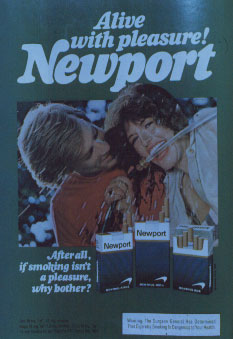
[an old ad; we've evolved
as humans in our ability to rationalize since then
(somewhat..i hope)]
is it clear that i make mistakes and need to see these mistakes scratched out in blue ink and later corrected in red?
yes, im very aware that typing out an essay on the computer is a faster and more effective means to output work. however, i need the feel of my thoughts on crumpled, dog-eared paper just as much as i need to have dried ink all over my fingers.
i am the bridge between the past of my parents' stationary means of expression and my children's computerized future.
that makes me the present.
here's what i have down so far (*note* slowly but surely, i am transcribing my essay on paper to microsoft word 2003):
[exerpt from my section - unofficially titled "media's effect on drug use"]
The mass media dramatically affects human life in so many ways. In North America and most of the developed world, there is little chance of a person being able to walk down the street without being bombarded by some form media advertising – whether it be through print, music & radio or television. The internet is another form of mass media rapidly taking over the visual and auditory spaces of the human psyche.
Media acts to shift an individual’s way of thinking. A medium determines how one may perceive certain people, places, practices or objects. At times, these perceptions lead to prejudices and outlooks whether false or true, that are negative and positive. Mass media has a strong influence in creating a positive perception of drug use leading to abuse and addiction.
Before media’s influence of drug abuse is discussed, it is important to understand the psychological impact of an advertisement. According to Daryl Bem’s ‘Theory of Self-Perception’, “we only have that knowledge of our own behaviour and its causation that another person can have, and that we therefore develop our attitudes by observing our own behaviour and concluding what attitudes must have caused them” (Stanton, 1996). In other words, people assume that the behavior of others and the context in which it occurs (e.g. ads) provides information about the presumed attitudes of the people (in the ads). If this notion is applied to alcohol advertisements for example, the consumer might conclude that drinking alcohol equates happiness and good experiences. Seeing a man and women together having fun and holding a drink – smiling, as most are in such ads, sends out the message that “you, too, can be this happy, but only if you drink this alcohol beverage”. Stated simply, the people are happy because they are drinking alcohol - which is obviously illogical. Believing that an alcoholic beverage or other product is the only means of gaining satisfaction in life is false and misleading on the part of the advertising firm and product corporations. Unfortunately, most individuals fail to see this. Because media is everywhere and ‘in your face’, advertisements have a lasting effect on your perception of these products.
First, cigarette advertisements consistently use language and images which contradict health label warnings and scientific evidence that smoking is hazardous. For years, the nicotine industry was convinced that tobacco products are not harmful. Today, cigarette companies ensure the general public that they make every effort to detail the harmful effects of smoking on their packaging. Meanwhile, contradicting themselves, tobacco advertisements promote their “dangerous & health-hazardous” products through their ads. In many cases, adolescents are the target demographic of these tobacco campaigns. Because the adolescent mind is not fully developed, this media-audience is swarmed with ads that motivate youthful and, in effect, long-term, life-long smoking habits. Adolescents are attracted by the lifestyle and reward that cigarette smoking advertisements promise. For instance, The Famous Marlboro Man illustrates an image of masculinity that young impressionable males look up to. Because the Marlboro man is a cowboy, he symbolizes a sense of heroism; his rustic and burly appearance represents a level of power and toughness that most males strive to be. The act of him smoking a Marlboro cigarette becomes an element of this masculinity when viewed by the male youth. When repeatedly observed, as most of these advertisements are in magazines and billboards, this image becomes ingrained into the mind. The male adolescent therefore, turns to smoking as a means of affirming his masculinity......
[an old ad; we've evolved
as humans in our ability to rationalize since then
(somewhat..i hope)]
About me
- I'm jay d
- From Ontario, Canada
- blah blah
- My profile
Previous posts
- ya-hoooooooooo~! bad breath, greasy hair, a bearde...
- [iron mike tyson] "my offense is impeccable; my...
- applying the concepts
- i am the most beautiful boogie man.
- coming soon...Posted by Hello
- eight days a week.
- the snow: it's neverending, dammit, neverending!
- a few looks back....
- so c'mon fatso and just bust a move.
- the greatest canadian.
Archives
- June 2003
- July 2003
- August 2003
- September 2003
- October 2003
- November 2003
- December 2003
- January 2004
- February 2004
- March 2004
- April 2004
- May 2004
- June 2004
- July 2004
- August 2004
- September 2004
- October 2004
- November 2004
- December 2004
- January 2005
- February 2005
- March 2005
- April 2005
- May 2005
- June 2005
- July 2005
- August 2005
- September 2005
- October 2005
- November 2005
- December 2005


0 Responses to “so far...”
Leave a Reply